
Portrait of John Barton the Elder (1754-1789), dated ~1774. (Click on image to download larger version).
Provenance
This portrait was given to John's son Bernard Barton the Quaker poet (1784-1849) in 1824 by his cousins in Carlisle, after Bernard's friend Mrs Sutton appealed to them. Bernard describes the gift and his joy at receiving it in a letter written to Rev. C. B. Tayler (in *Barton 1850 p43; also extracted in *Lucas 1893 p69):
"My head and heart are full even to overflowing: my eyes are almost dim with gazing at one object, yet are still unsatisfied. I keep thinking of one thing all day, stealing to feast my eyes on it when I can, and lie down to dream of it o' nights. In one sentence, my good cousins at Carlisle have sent me my dear, dear father's picture. It is in most excellent preservation, not at all injured by the journey, and I write tonight to a friend in town to arrange for its being neatly framed. But I must describe it.
Its size is about four and a half by rather more than three and a half feet; how I wish our parlour were a little larger! My dear pater is seated at a round table, his elbow resting on it, and his right hand as if partly supporting his head; the little finger folded down, the two fore ones extended up to his temple. Before him is a sheet of paper, headed "Abstract of Locke;" the chapter on Perception, and the first volume of Locke, open, is on his left hand, on his knee. His countenance is full of thought, yet equally full of sweetness. What an ugly fellow I am compared to him ! A little further on the table is a German flute, and a piece of Handel’s music, open, leaning against Akenside's Pleasures of Imagination. A larger volume also lies on the table, lettered “Kenrick's Dictionary,” and several letters, the date of one of which, at the bottom, is March, 1774. (I conclude the picture was painted then.) In the corner, just below the table, stands a globe. On the book-shelves behind him are, first, a volume the first line of the title I can't make out -- "on Euclid;" then, I think, "Simpson's Algebra," "Fitzosborne's Letters," another book lettered, I think, "Verularu," " Fordyce," Pope's Works," "Dictionary of Arts and Sciences," two or three volumes. The titles of the upper row of books are hid by a sort of curtain.
An open window on the other side of the table gives a peep of sun-set sky. His dress is a suit of so red a brown as almost to approach to crimson; his hair turned back from a fine clear forehead, with a curl over each ear, and tied in a sort of club behind : the rufflles at his wrists, as well as a frill, to say nothing of the flute, show that he had not then joined the Quakers. His age when this picture was taken I suppose about twenty. I think I understand it was the year before his marriage. His countenance is all I could wish it (delicately fair, which I had always heard, and rather small features) in the bloom of youth, yet thoughtful to me full of intellect and benignity. O how proud I am of him!"
Thereafter, according to the notes of Andrew Humphries, the picture passed to Bernard's daughter Lucy Barton (1808-1903), who having no heirs of her own passed it on to Josephina Rickman (1808-1892), who passed it on to her nephew Rev. John Barton of Cambridge (1836-1908). It then went to John's daughter Jessie Barton (1874-1955), living at 22 Barton Road, Cambridge, who again had no heirs of her own. When she died in 1957, she left the picture to a son of her late brother Jack: Rev. Ray Barton (1905-1975), who in turn left it to his nephew John Barton, brother of Malcolm Barton. It now (in 2012) resides with John's son Bernard.
Painted by George Haugh?
The portrait is not obviously signed. Malcolm has for some time sought to determine who painted it. Carlisle historian Denis Perriam suggested that it may be an early work of George Haugh.
Now better known for his animal portraits , Haugh began his life and career in Carlisle. According to this article by Mr. Perriam, (also reproduced here ), Haugh's father had a barber shop and a family home on English Street. According to Andrew Humphries, John Barton lived on the same street before moving to London in 1783. George Haugh began his training with the Royal Academy of Arts on 15 October 1772, when he was 16. A letter in the John Barton portrait is dated 1774. In April 1775, local paper The Cumberland Pacquet (to which John Barton contributed) praised one of Haugh's commissions, a dog portrait for a Carlisle owner.
There do appear to be stylistic similarities between the John Barton portrait and one of Haugh's other human portraits: "The Countess of Effingham with Gun and Shooting Dogs", particularly in the slender willowy form of the arms:
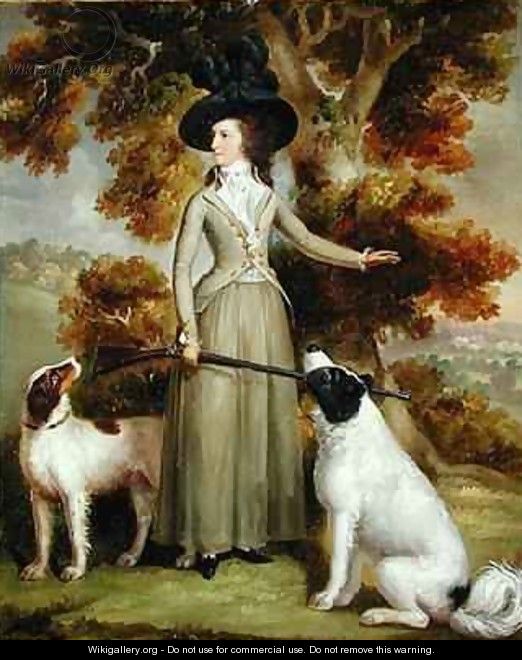
Image from Wikigallery.org
The name "J. Ware"
Among the letters on the desk in the portrait is the signature "J. Ware".
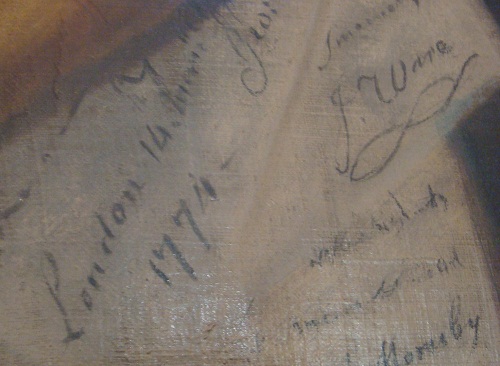
John Ware was the founder and printer of the Cumberland Pacquet, the local newspaper published between 1774 and 1882 to which John Barton regularly contributed opinion pieces under the pseudonym "Hiero" (Ware was also the first person to translate the bible into the Manx language). Hiero' columns are always addressed "To the Printers of the Cumberland Pacquet": the printer was also the editor in those days.
The music
The music on the stand has been identified by Kristina Bartlette as the two flute parts from Handel’s Water Music (1717).